Four of you on the footpath. Twenty minutes gone. Someone asks "I don't mind, what do you feel like?" for the third time and means it, which is exactly the problem.
Nobody has a preference strong enough to defend, and nobody wants to be the person who picked badly. So it loops, until someone finally names a place out of exhaustion rather than appetite and everyone agrees a bit too quickly.
A lunch decider wheel breaks that loop by removing the thing causing it. Not the lack of options — the reluctance to own the choice.
What it actually is
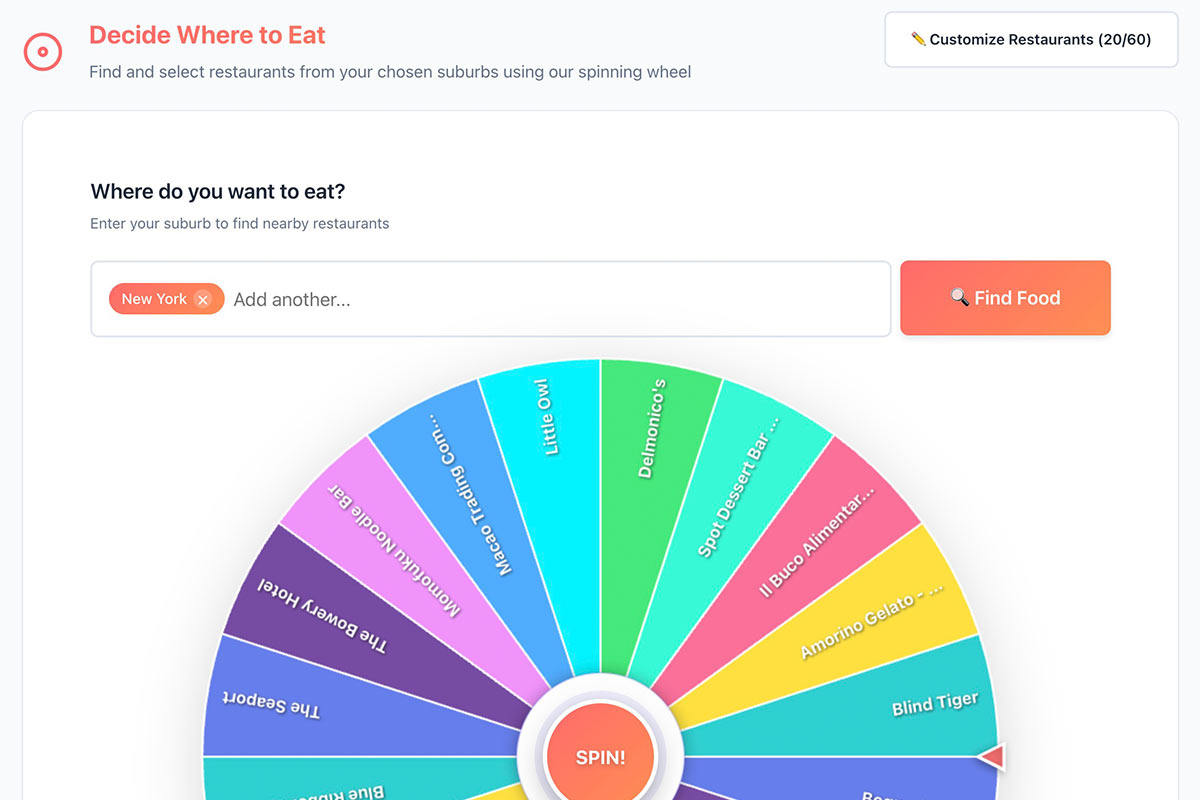
A wheel with restaurants on it. You spin. It picks one.
That's the entire mechanism, and the simplicity is the point. No algorithm weighing your order history against the weather. It's a coin flip with more than two sides.
Why randomness beats discussion here
Nobody is responsible. The wheel chose, so nobody has to defend the pad thai if it turns out average. That one fact dissolves most group food arguments, because most group food arguments were never really about food.
It's over in seconds. The debate is usually longer than the meal deserves. Twenty minutes to choose between places you'd each be perfectly happy with is a bad trade at any hunger level.
It breaks the rotation. Left alone, most of us cycle through the same three places indefinitely. Put the ones you've been meaning to try on the wheel and you'll eventually be sent to one. Chance is better at pushing you out of a rut than intention is.
The pact is the load-bearing part
None of this works if the result is negotiable.
If you spin, pull a face, and say "best of three", you've reintroduced the decision with extra steps and a worse mood. Agree before anyone touches the wheel: one spin, and we go.
Genuine exceptions are fine — it's closed, someone can't eat there. "I'm not feeling it" isn't one. You weren't feeling anything in particular. That's why you spun.
What separates a good one from a bad one
You're spinning within thirty seconds. If setting it up takes longer than arguing would have, the tool has failed at its only job.
It works on a phone. Nearly every one of these decisions happens standing on a corner or slumped on a couch. A wheel that needs a mouse is decorative.
It shows you enough before you commit. Rating, whether it's open, roughly how far. Enough to strike the obvious non-starters before spinning, not so much that you start browsing again.
It doesn't want your email. Handing over an address to find out where to get lunch is a bad deal.
Getting more out of it
Be specific about where you are. "Melbourne" gives you the whole city. Your actual suburb gives you places you can reach before your break ends.
Search a suburb over. Stuck in a rut is usually a geography problem, not an appetite problem. One suburb across is a different set of restaurants entirely.
Prune before you spin, not after. If there's something on there you'd genuinely refuse, take it off first. The wheel only works if you'd accept any outcome.
What LMDFY does, plainly
You type a suburb. We ask Google Places what's nearby and well rated, put the results on a wheel, and spin it. It's free, there's no account, and there's no upsell.
To be straight about the data: your location does go to our server, because that's how we look up what's near you. We keep aggregate counts — how many spins happened in an area, which days are busiest — and we don't build a profile of you, because we have no idea who you are. There's nothing to log in to.
Other things we've built
The same idea applies to plenty of small decisions:
- Yes or No — binary questions
- Coin Flip — the classic
- Dice Roller — D4 through D100
- Random Number — pick a range
- Name Picker — draws, turns, giveaways
All of them are on the wheels page.
The honest case for it
A lunch decider wheel doesn't find the best restaurant. It can't. It has no idea what you feel like, and on the evidence, neither do you.
What it does is close off a decision that was never going to reward the effort. Nearly every place you're weighing up will feed you perfectly well. The gap between the best and worst outcome is one adequate dinner, and you've been spending twenty minutes a night defending it.
If you want the general version of this argument — which decisions deserve your attention and which are quietly robbing you — we wrote about that in making better decisions without overthinking.
Otherwise: pick a suburb, spin, go eat.